Showing posts with label GBBR. Show all posts

Wednesday, September 2, 2020

Fall: A Rainbow of Colours

It’s that time of year where the weather gets colder and the leaves on the deciduous trees (trees which drop their leaves) begin to change colour.
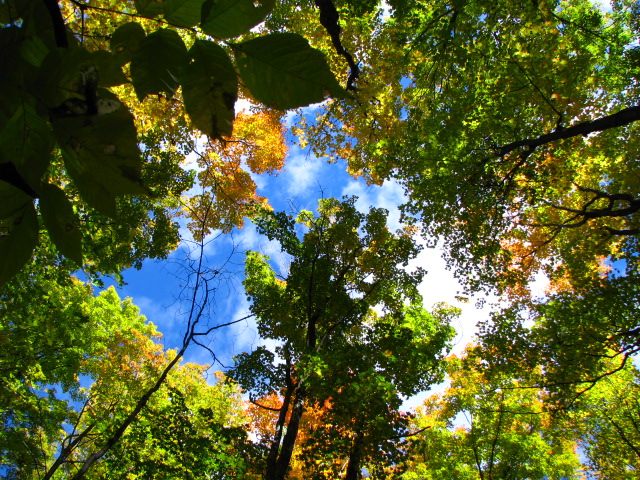
 Why do tree leaves lose their green colour? Before we can answer that question, it is important to know  what makes leaves green. Inside all the leaves' cells are pigments called chlorophyll. Chlorophyll is what allows the leaves to absorb light and convert it into energy that can be used by the tree. Chlorophyll absorbs blue and red light and as a result reflects the green colour we see.

When the trees begin to go dormant for the winter, the chlorophyll will start to break down. The shorter days mean less sunlight and this is a signal to many species that winter is coming. Green chlorophyll is one of four pigments inside the leaves. As the chlorophyll breaks down we see the other pigments show through. They are actually there the whole season but the chlorophyll prevents us from seeing them! The other pigments are xanthophylls which appears yellow in leaves, carotenoids which appears orange, and anthocyanins which shows red.
 

When the leaves eventually turn brown, it means the additional three pigments have also broken down, just like chlorophyll.


Important: Don't Rake Leaves!

Fallen leaves are free, natural mulch and fertilizer for your lawn and garden. Fallen leaves are a natural part of the decomposition cycle and they help feed other plants and insects when they start re-growing in the spring. You only have to go over them with the lawnmower, and allow some time to pass before you won't even remember that they were there! Your yard will thank you!


Activity Corner

Falling leaves offer hours of entertainment! Here are a few ways to make the most of it:

  1. Catching leaves: Challenge your family and friends to try and catch as many leaves falling from the tree before they touch the ground. On a windy day, set a timer for five minutes. Whoever catches the most leaves from the air in that time wins!
  2. Leaf pile jumping: I’m sure many of you have done this before, but that probably means it’s a lot of fun.
  3. Leaf crafts: There are endless leaf crafts for people for all ages. Here are a few ideas:
  • Using a metallic marker draw and create new patterns on leaves you’ve collected. (these can make great name tags for your thanksgiving dinner)
  • Make a wreath out of fall leaves by sticking them together with mod podge. Cut out a cardboard ring to glue them too.
  • Collect your favourite fall leaves and learn how to press them in a book to preserve them.

Tuesday, August 25, 2020

Fuzzy Wonders: Woolly Bears

Even though many of us may be returning to school, that doesn’t mean it’s time to stop exploring the outdoors. It’s around this time of year that one of the coolest and cutest critters starts to crawl around: woolly bear caterpillars!

Seeing a woolly bear is considered to be a sign of the changing seasons from summer to fall for many people across North America. The woolly bear's range stretches from the northern parts of Mexico, throughout the United states and into southern Canada.


You have probably seen these fuzzy caterpillars before, maybe on a walk to school, around the park, or even in your own backyard. Although easily recognized, most people don't know what to call them, and sadly don't know all the exciting traits they have. Let’s dive into some questions you never knew you needed to ask until now.


If woolly bears are caterpillars... what butterfly do they turn into?

Woolly bears do not turn into butterflies! They actually turn into the Isabella tiger moth. These moths have a 2 inch wingspan and are a light yellow colour with black spots.


It's almost winter and there are still caterpillars crawling around! When are they going to become moths?

A woolly bear will not turn into a moth until next spring or early summer. The caterpillar will keep munching on leaves until winter begins. 


If they wait until spring to become moths, how do they survive the long, cold winter?

A woolly bear, unlike most caterpillars, will remain a caterpillar all winter, unlike other species that overwinter as a pupa (in a cocoon). The woolly bear will roam the forest floor, across trails and roads to find a good dark spot under leaf litter or under logs to spend the winter. When the temperatures get below freezing, this caterpillar produce a chemical in their body that acts like an antifreeze. This makes sure their blood doesn’t form ice crystals. Wow!


Is it safe for me to pick up a woolly bear?
YES! There are some species of caterpillars you should not touch (because their "hairs" or spines can irritate your skin), but woolly bear caterpillars are safe to touch. This fuzzy caterpillar is exactly that … FUZZY. It's hairs are probably there to trick predators into thinking they are toxic so they don’t become a meal. So next time you're outside and find a woolly bear caterpillar, you can gently pick it up, pet it, and see for yourself how fuzzy they are!


Is it true that the length of the brown band predicts the kind of winter we'll have?
This is a common belief: the length of the brown and black bands on the woolly bear caterpillar tells us if we will have a cold snowy winter or not. The legend goes, if the brown band in the middle is short, we will have a cold, snowy winter. On the other hand, if the brown band is long we will have a mild winter. It turns out that these caterpillars don't actually tell us about the weather. The length of the bands depends on the caterpillar's age and how much it was able to eat. If the middle brown band looks short, it means that the "ends" of the caterpillar (the black parts) have been growing a lot. Probably that caterpillar ate a lot and was able to grow quite long. 


Thursday, July 30, 2020

Pollination Nation: It's the Bee's Knees!

We hear the word pollination more and more now, but what does it actually mean?

Pollination is the process of pollen traveling from the male part of the plant to the female part of the plant (or to a different plant) so that the plant can make seeds and fruit.

Wait a second! Plants have male and female parts?

Yes! The stamen are the male parts of the plant and that is where pollen is produced. The female parts of the plant are called the pistil and this is where the plant's ovary is located.

So, how are plants able to transfer pollen anyway?

Pollen moves around by taking advantage of wind, water, or with the help of pollinators. Pollinators are animals, often insects, that eat sweet nectar produced in flowers. Plants actually produce nectar to attract the pollinators to them! When the animal or insect feeds on nectar, they can't help but touch the pollen which sticks to them. As they travel to multiple plants, the pollen is spread and this is the process of pollination. Hummingbirds, butterflies, and bees are a few of the pollinators that live in the biosphere.

Most plants grow flowers but you will have noticed the huge differences in flower size, shape, colour, and even when a plant blooms - this is no accident! Plants pull out all the stops to try and attract different pollinators. From producing beautiful smells and tasty nectar to having very bright coloured blooms. The shape of the flower can also entice certain animals and insects.

The pink lady slipper is a flower in the biosphere that is designed to make sure the pollinator completes its job of getting the pollen to the ovary of the plant. Once the bee enters the flower it has to crawl through a tube in the flower and exit through the other side!


Flowers also have a hidden signal! Light not only allows us to see but it also gives everything colour! Humans can only see visible light, which gives us the colours in the rainbow, but some pollinators can see UV light too! Some flowers attract pollinators with beautiful UV light patterns. Here is an example of how some bees might see these flowers:


Pollinators like bees are designed to pick up LOTS of pollen on their bodies as they feed on nectar. This helps pollen travel and is necessary for the majority of flowers to produce seeds and fruit. Pollination is important for many species and entire food webs, not just the plants.


What’s happening to pollinators?

Honeybee populations have been declining over the past few years. Scientists think the decline in their populations  is from combinations of disease, pesticides, poor nutrition, climate change, and habitat loss.

Industrial agriculture and the use of pesticides on crops are harming bees. Pesticides and chemicals used to protect crops from pests can dissolve in water. They become mixed into runoff water which travels and can then be absorbed by plants miles away. These pesticides end up in the pollen and nectar of flowers and consumed by bees. These chemicals do not kill the bees right away, it takes time. In fact it has more of an affect on the queen's ability to lay eggs. The chemicals lower the amount of eggs that can be produced by the queen.

Parasites are also attacking bees. A parasite is a tiny creature that feeds on a larger host animal in order to survive. In the case of the bee a very tiny parasitic mite feeds on the bees fat cells. These mites have a scary name Varroa destructor mites and can transmit five different illnesses to the bees.


The last major factor affecting bee populations is the loss of habitat. Cities and industrial agriculture are removing available pollinator habitat. There are fewer native flowers and specific plants that support the life cycles of a variety of pollinators, especially bees and monarch butterflies. This is where you can help out! The actives below are two great ways you can help out the pollinators.

Activity: Make A Mason Bee Hotel

There are over 100 species of solitary bees in Ontario - they don’t live in a hive. Solitary bees rarely sting because they don’t protect a queen. Their number one priority is finding food… and pollinating!
Help promote biodiversity by giving solitary bees eggs a safe place to develop, a mason bee hotel!

Materials: Aluminum can, scissors, paper straws/bamboo cane or make your own nesting tubes using parchment paper by wrapping them around a pencil and securing with glue.
1. Measure and cut the nesting tubes to fit vertically inside the can.

2. Fill the can with nesting tubes until they are secure and don’t move around.

3. Find a location for your mason bee hotel so that it:
  • Won't move around in the wind,
  • Will be well protected,
  • Will get lots of sun, and 
  • Is at least 3ft above the ground.

4. Optional. Consider planting some native flowers near the mason bee hotel! Wild columbine and black eyed Susan’s are favourite flowers for bee’s and butterflies. Milkweed species aren't just for Monarch butterflies, bees like them too! Learn more about native plants species here.

Thursday, July 23, 2020

Toad-day's the Day!


Have you seen a toad in the Biosphere? I’ll bet you have! For some reason, we sometimes hear that toads are yucky and ugly, but once you get to know toads you will learn that they are TOAD-ally awesome animals!

Let’s start by clearing up some confusion. Toads are similar to frogs but not exactly the same. It’s kind of like they are cousins! Both toads and frogs are amphibians, meaning they spend part of their life living in the water and part of it living on land. Check out the table below to see how frogs and toads are different and similar.


In Ontario there are 2 species (types) of toads: the American toad and the Fowler’s toad. Chances are you have seen an American toad but not a Fowler’s toad. This is because American toads live all across Ontario, but Fowler’s toads only live in a few places in Ontario (on the north shore of Lake Erie).

Toads can be found in a variety of habitats, from lawns to forests. As long as toads have food and shelter from predators, they aren’t too picky. Unlike frogs, toads can live far from water. This is because toads’ dry, thick skin prevents their bodies from drying up, so they don’t need to spend as much time in the water.
American Toad photo by Kayla Martin


TRICKY TOADS

We love to see toads but toads don’t like to be seen! Their bumpy brown skin helps them hide among leaves, fallen logs, and rocks on the ground. This method of hiding by looking just like the surrounding environment is called camouflage. Toads also avoid being seen by being most active at night, when many predators (animals that might try to eat them!) are asleep.

Did you know toads have a secret defense, just in case a predator tries to eat them? Underneath their bumpy skin toads have glands (groups of special skin cells) that produce a toxic poison. They store the poison in the Parotoid glands –those bumps behind their eyes. If a predator (like a snake, hawk, heron, or raccoon) tries to eat the toad, the toad oozes white goo that contains the toxins from these glands. It tastes gross and can make the predator sick, so they might spit out the toad and leave it alone. In case you were wondering, these toxins are not dangerous to humans unless you swallow them or get them in your eyes.

TRANSFORMING TOADS

Did you know that toads transform into different body shapes throughout their lifetime? In spring, adult toads go to wetlands (like ponds, slow rivers, and marshes) to breed. You can hear males making a loud trilling sound in spring as they try to attract females. Listen to the toad trilling tune below:
After mating in the water, female toads lay their eggs in the water so that the eggs won’t dry up. Toads lay all their eggs in a strand. The eggs develop into tiny baby toads, called tadpoles.Toad tadpoles look nothing like adult toads!  They have no arms or legs but they have a tail and gills so they can live underwater. As the tadpoles grow bigger, they grow their legs first. Next, they grow their arms and at the same time their tails start to shrink. They also develop lungs that allow them to breathe air.

This whole process slowly happens over about 2 months. At the end of the process, the teeny tiny toads (called toadlets) hop out of the water and go explore land in search of bugs to eat. Eventually they grow into adult toads and if they are lucky they can live to be around 10 years old. There might be a toad out there that's the same age as you!


ACTIVITY: MAKE A TOAD ABODE

Would you like to have a toad for a neighbour? Toads can help you out in the garden, too! Toads love to eat bugs, slugs, and other little creatures that try to eat our garden plants. By inviting a toad to live nearby you can help keep your garden growing because the toad will help keep the pests under control. 
Toads make great neighbours. Photo by Kayla Martin

Toads like to have shelter to hide in. A great way to encourage toads to live in your yard is to provide them with shelter. We like to call it a toad abode, because abode is another word for a home and "toad abode" is fun to say. It's very easy to set up a toad abode!

1. Find a small clay container, about the size of a mug or slightly smaller. I used a small clay flower pot! You may decorate it with paint if you'd like. 

2. You know what they say about real estate: "location, location, location!" It's important to choose a good location for your toad abode. Find a spot in soil/sand with plants to provide some shade. 

3. Time to set up your toad abode! Luckily the construction process is very easy. Just dig a little ditch in the soil or sand, then lay the pot on its side in the ditch. Set it so that most of the pot is above the ground, but a little is below. Spread some of the soil into the pot and pack some of the soil around the sides of the pot so the toad abode stays in place. 

4. Be patient and hope that a toad finds the new toad abode! In the meantime, be proud of your efforts to help local toads and remember all the cool things you learned about toads!


Blog post by Kayla Martin, July 2020

Thursday, June 25, 2020

Quick Tick Tricks


Ticks are NOT insects! Does that bug you? 


Ticks are actually arachnids, just like spiders and mites. Ticks eat the blood of living animals, almost like little mini vampires (minus the cape and spooky castle). Ticks latch on to the skin of their host animal – usually some sort of mammal or bird. It’s called a host animal because it provides things that ticks need (such as food)… even though the animal may not want the tick!


Ticks are tiny all through their life stage. Tick larvae and nymphs are about as big as a poppy seed. Adults ticks are about as big as a sesame seeds but they can be almost as big as a grape when fully engorged with blood. 


In Ontario we have two species of ticks: deer ticks (also called black-legged ticks) and dog ticks. Ticks in Ontario can be found in a range of habitats, but usually they like areas that are grassy and forested (with leaf litter). They are also found in gardens!


Sick of Ticks: Diseases from Ticks

Sometimes ticks can transmit diseases to their hosts. The diseases can make the hosts (people and other animals) very sick, even though they don't make the ticks sick. Deer ticks can transmit diseases including Lyme disease. Dog ticks can transmit diseases including Rocky Mountain Spotted Fever. 


We have deer ticks in the Georgian Bay Biosphere, so there is a risk of getting Lyme disease from a deer tick. Lyme disease has been reported from across Ontario, including parts of the Biosphere. Even though we have dog ticks in the Biosphere there have been no cases of Rocky Mountain Spotted Fever. The disease is thought to be farther south for now.

Lyme disease is an infection caused by a bacteria that lives in Deer Ticks. The bacteria doesn’t make ticks sick, but it can make other animals (including humans) very sick. Ticks usually require 24—48 hours of being attached to the host before they can transmit Lyme disease. This is why it’s important to check for ticks soon after you come indoors!


Keep Things Right: Prevent a Bite

  • Check your entire body after being outdoors in areas where ticks might live. Remember to check hard-to-see places like behind your ears, in your armpits, and behind your knees!
  • Try to shower within 2 hours of being outside.
  • Put your clothes in the dryer on high heat for 10 minutes
  • Use bug spray with DEET or icardin
  • Be tick a-"wear" and wear clothing to prevent tick bites (see image below!)
  • Stay on trails and pathways to avoid brushing up with vegetation


Tick Off: Removing a Tick

  • Use clean tweezers to grasp the tick by its head and slowly pull straight backwards and upwards to remove the tick from your skin
  • Instead of tweezers, you could also use a special tick-removing tool called a Tick Key
  • Place the tick in a sealed bag or container so that you can send it for testing if it’s a Deer Tick or if you’re not sure
  • Wash the area with warm soapy water
  • Keep checking the bite area to look for any redness and/or swelling
  • Check the Public Health Agency of Canada for next steps
  • Contact your health care provider if you are worried or feeling unwell


More Resources for You and Your Family


Thursday, June 18, 2020

The Summer Solstice

You may have noticed that the days are getting longer and it's staying brighter later and later each night. This is because we are getting closer to the summer solstice, the day with the most sunlight hours all year! On June 20th, 2020 the sun will travel across its longest path in the sky this year, giving us 15.5 hours of sunlight. The sun will rise at 5:30am and it will set just after 9:00pm for us on eastern Georgian Bay.


How does this work? Why do the hours of sunlight change? Why do we have shorter days in the winter and longer days in the summer? All these answers relate to how our planet rotates around the sun.

There are two ways Earth moves that are important for all life:
  1. Spin: The movement of the Earth that gives us day and night. It takes Earth 24 hours to complete one spin.
  2. Rotation: The route the Earth travels around the sun. It takes one year to complete one rotation.
In addition to planet Earth's spinning and rotating, it is helpful to know it is also on a tilt. This means it has a slight angle as if it were leaning to one side. Billions of years ago a piece of space rock the size of Mars (but much hotter!) collided with Earth. The collision was so intense the Earth moved, giving it the tilt it has today.

The tilt is what causes Earth's seasons and creates summer and winter solstices, giving the planet more or less hours of sunlight. The summer solstice is the moment the northern hemisphere is at its closest point to the sun during its one year rotation. We get longer, warmer days when the northern hemisphere tilts closer to the sun in summer and we get shorter, cooler days as we tilt away from the sun in winter.

Fun Fact: The rock that hit Earth billions of years ago did more than just give us seasons. A fragment of that rock still influences life on Earth every day and you can see it almost every night. It’s the moon! The moon was a part of an ancient asteroid that slammed into Earth. The moon became stuck in Earth's gravitational obit and now controls the tides!


A riddle for you: Sarah's birthday is on December 18th but somehow her birthday always falls in summer. How is this possible? Answer below!

The summer solstice is a time of celebration for many cultures around the world as it marks the beginning of many growing seasons. Here in the Biosphere, strawberries are among the first harvest ready to be eaten around this time of year. The summer solstice also marks National Aboriginal Day. On June 20th 2020 let's go outside and celebrate the beginning of summer on the longest day of the year.


Activity: Create a Sundial
It is not known exactly which time period sundials came into existence but they have appeared in many ancient civilizations around the world. It's about time you try setting up your own sundial!

Here's how:
  1. Using the back of a paper plate as the face of your sundial, write the 12 hours of the day around it like a clock face and decorate it to your heart's content.
  2. Carefully poke a hole through the centre of the plate and place a pencil or wooden rod through the hole.
  3. You might need to tape or glue the pencil so that it can stand up.
  4. Bring the sundial outside and align the 12 on your clock with north*. You could also try matching up the time with a real clock to start.
  5. You might need to put a small rock on the paper plate to keep it from blowing away. 
  6. Let the sun do the rest of the work!How accurate is your sundial?
*Not sure how to find north? Most phones or GPS’s have compasses built into them. If you don’t have a compass, find out where the sun rises (this will be east) and sets (this will be west) and you can get a good idea of north.


Riddle answer: Sarah lives in the southern hemisphere!! When the Earth is rotating around the sun the southern hemisphere is always opposite to us up here in the northern hemisphere, so when we are in winter and have short days they are in summer and have longer days!